
2.16.23
The US is trying to shut crypto's water off and ... yeah, I mean that's pretty not great

It’s been a few weeks. Life and work gets in the way sometimes. I thought I could slow-play the beginning of this year as it seemed like the crypto markets could breathe again. Silly me. I hope you enjoyed your monthlong break from the fight; war is back on our doorstep. Suit up.
If you want to know what the mood is this week, this tweet just about sums it up.

🫁 Operation Choke Point is Real
We are going to start with required reading from Nic Carter here on the US government using its banking sector to execute a widespread crackdown on all things crypto. I will not regurgitate his words so please take the time to read it, I’m more than happy to wait.
I have a feeling that you’ll find your transformation from non-conspiracy theorist to ‘shit, I guess I do believe in conspiracy theories’ to be a concerningly quick one. Especially since headlines like this are just the tip of the iceberg.
Let’s hit two highlighted excerpts for those of you who didn’t heed my suggestion to read the full piece above:
In sum, banks taking deposits from crypto clients, issuing stablecoins, engaging in crypto custody, or seeking to hold crypto as principal have faced nothing short of an onslaught from regulators in recent weeks. Time and again, using the expression “safety and soundness,” they’ve made it clear that for a bank, touching public blockchains in any way is considered unacceptably risky … the writing is on the wall, and the investigations into Silvergate are a strong deterrent to any bank considering aligning itself with crypto. What is clear now is that issuing stablecoins or transacting on public blockchains (where they could circulate freely, like cash) is highly discouraged, or effectively prohibited.
The ironic thing is that physical cash — completely peer-to-peer and private — would be illegal if invented today. Think about that. So this seems like an unreasonable way to approach new technology. Maybe it gets better …
Today, the outlook for banks remotely interested in crypto is precarious. Bankers tell me that crypto is toxic and the risks of engaging with the asset class aren’t worth it … Banking innovations at the state level, like Wyoming’s SPDI for crypto banks, appear dead in the water. Federal Charters for crypto firms with the OCC also look dead in the water. Traders, liquid funds, and businesses with crypto working capital are nervously examining their stablecoin portfolios and fiat access points, wondering if bank connectivity might be severed with little notice. Privately, entrepreneurs and CEOs in crypto tell me that they sense a regulatory noose tightening. As crypto-facing banks ‘derisk,’ younger and smaller firms will struggle to get banking, taking us back to the 2014 to 2016 period when fiat access for crypto businesses was at an extreme premium … As a venture capitalist operating at the early stage, I am directly witnessing the chilling effects of this policy in action. Founders are reckoning with new uncertainties around whether they’ll be able to operate their businesses at all.
A real-time example of this? The Federal Reserve denying Custodia Bank membership. Custodia has spent the last 18 months waiting for a decision. Want to know why bad actors become the faces of crypto? Because the good actors who proactively approach regulators and share a genuine interest in working with them are ignored, shut out, and cut off at the knees. God forbid we encourage collaboration with those who are making crypto safer by limiting rehypothecation risks and creating a more regulated option for on- and off-ramps.
Related to this: crypto businesses moving or incorporating offshore is absolutely true. There is growing fear from founders about the uncertainty that they and their businesses face when operating under a regime that refuses to provide guidance of any sort. It is far easier to set up camp offshore, ‘block’ US users from using their products directly, and wait this all out.
In the meantime, three things are happening:
the US is falling behind on crypto, an innovation that at its foundation should theoretically align closely with the country’s ideals of democratization, by pushing entrepreneurs elsewhere;
US-based crypto users are missing out on innovative products that give them greater access to services that can improve their lives; and, importantly,
the foundation is being set for an FTX 2.0 — yes, most of those moving or incorporating offshore today are well-intentioned actors simply trying to build from a place of safety; however, as more entities move offshore, more entities build without regulatory oversight, and human nature eventually kicks in … when that happens, do not let anyone tell you it was ‘shocking.’
I work at the intersection of banking and crypto so I will now be quiet.
🚧 Regulators Have Lost the Plot
If these last few weeks have proven anything, it’s that the US government has lot the plot.
It started with the Biden Administration releasing a ‘roadmap’ to mitigate the risks of cryptocurrencies. Given the nature of the post — which implied throughout that crypto is predatory and immoral — and the fact that it came the same week as the Fed’s denial of Custodia, a coordinated anti-crypto effort in line with that described above seems more than reasonable. We aren’t allowed to believe in coincidences.
(For some reason, providing clear regulation and going after conmen before they build $10B+ Ponzi schemes weren’t focuses for this ‘roadmap.’)
Fast-forward a few days and the SEC, led by the Guardian himself, Chair Gary Gensler, has sent notices going after several of the largest, longest-tenured, and legitimate businesses in the industry, attacking them on technicalities and regulatory overreach allowed only because the rules have been kept unreasonably vague. This seems like a good time to remind you that it’s been four years since the SEC provided crypto-related guidance. Four. Years.
(Four years ago, staking existed almost entirely in concept; now, proof of stake protocols dominate the non-Bitcoin industry. There was ~$300M of total value locked in DeFi protocols; there is now $50B+. There were ~$3B of stablecoins in circulation; there are now nearly $150B. The industry hasn’t just grown, it’s become unrecognizable to where it was four years ago.)
So let’s see what Gary’s been up to the last few weeks.
Kraken entered into a $30M settlement with the SEC because of allegations that it broke the agency’s rules around staking products. The SEC isn’t attacking staking directly — yet — but rather forcing Kraken to shut down its staking services because their customer disclosures weren’t up to the SEC’s standards. If only Kraken had spent 10 years building and operating a trusted business and tried to proactively work with the SEC … 🙄.
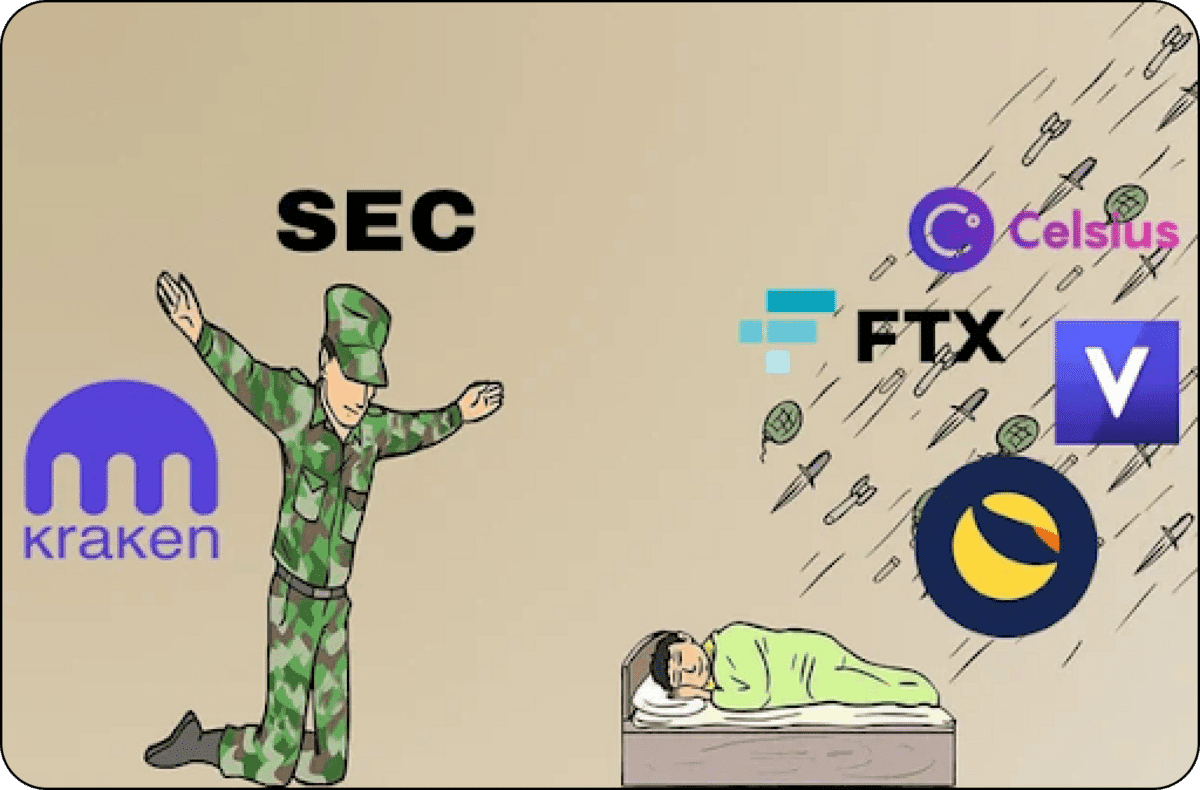
This settlement continues to reflect the SEC’s strategy: regulate through enforcement to ‘clean up’ the industry by going after those who have operated legitimately. It also may act as a precursor for a more wholistic attack on staking services, regardless of technicality trip-ups. Don’t be surprised for the SEC to use staking as a way to label crypto assets like ether as securities; the day that happens, I expect this site to see record traffic.
The SEC’s own commissioner, Hester Peirce, publicly rebuked her agency’s approach, calling it ‘paternalistic and lazy.’ Coinbase CEO Brian Armstrong is ready to fight any action that comes their way.
Gensler then had the audacity to go on TV and send a warning shot to other crypto platforms, telling them that they should ‘seek to come into compliance.’ Seek help, Gary.

One surefire way to discourage compliance is by specifically targeting the companies that proactively work with regulators. By opening up their books and business models in asking for guidance, they become the low-hanging fruit in a regulatory sandbox that has no walls, lines, or direction.
Next up: The SEC is planning to sue Paxos in connection with its issuance of the Binance-branded stablecoin BUSD. Paxos quickly halted its minting of BUSD in response, and PayPal paused its own plans to issue a stablecoin shortly thereafter.
Reading between the lines, this looks like the SEC taking the scenic route to getting to Binance’s books, using Paxos as the intermediary.
Even so, the intermediary still has to deal with the lawsuit at hand, one that is seeking to label BUSD a security, and therefore one that places Paxos in hot water for not registering that ‘security.’ As mentioned above and covered ad nauseam, the SEC hasn’t actually provided any guidance around what constitutes a security.
What should seem quite clear is that a non-interest bearing, fiat-backed stablecoin is not a security, and if it is, that argument should be made publicly and well before an enforcement action is brought forward. Coinbase, Circle, and USDC are on deck.
The US was born on third base in crypto: stablecoins were a gift to extend the dollar’s dominance, the country was the world’s magnet for entrepreneurial talent, and its democratic values should have made clear the importance and potential of open source technology and the democratization of access. Yet we’re rounding second, heading to first.
And as if all of that wasn’t enough, the SEC dropped a piano on the industry’s venture capital firms and custodian providers, proposing to amend federal custody requirements.
This would mandate that custodians, including crypto exchanges, secure or maintain certain federal or state registrations … while regulators actively work to make it more difficult for those same custodians to acquire the necessary approvals for those licenses. (See: Operation Choke Point above.)

This could have two outcomes, each destructive: it will either cement the competitive positions of those that already have ‘qualified custodian’ designation — eliminating service competition and punishing firms for holding assets that the existing qualified custodians don’t support — or strip existing qualified custodians of their designation, pushing investment advisors and hedge funds to use legacy banks for custody of assets that those banks don’t actually have the technical understanding to support.

Gensler is like a blinded fighter throwing haymakers in every direction, hoping something hits. Except he’s doing it to an entire industry to further his political career at the expense of public interest.
For a man who holds some $50-100M+ in personal assets, he is burrowed quite deep into the pocket of a politician who, for all of her strengths, has absolutely missed the mark on crypto.
The Guardian is playing a short term game; when he loses, the only question will be how far back he will have set the US.
Checks out. Every morning for the past week I’ve woken up to this from the SEC:

Still, there is a dim hope on the horizon. Get your popcorn ready.


Meanwhile, the UK has revealed its plans to work with the industry on regulations around crypto activities while the EU is easing the regulatory burden for crypto smart contracts laid out in its draft legislation. Hong Kong is positioning itself to become a hub for crypto activity. What a concept.
🙄 The FTX Update
The last section was heavy so we’re keeping this one extremely lean. FTX’s interim CEO John J. Ray III dropped some bars to the WSJ. Highlights:
He’s open to restarting FTX to get funds back to customers. Go for it, but I’m never typing in the letters F-T-X to a website again.
He took shots at Sammy Substack and his newsletter claims about the solvency of FTX.US. Johnny Ray was even kind enough to point out that Scammin’ Sammy counted $250M of cash in his calculations that’s in LedgerX, the US derivatives trading platform that was purchased with … (drum roll please) … customer deposits! It seems Sammy still hasn’t learned his lesson.

Other news of note:
The Feds seized almost $700M of SBF’s assets in cash and equity. But he told us he only had $100K in his bank account! Could he have lied?
US federal prosecutors have alleged that Slippery Sam used $400M of money taken from FTX users to invest in a relatively unknown investment firm run by an ex-girlfriend of his and operated out of the same Bahamian compound. $300M was invested just before FTX collapsed in early November. Nothing shady there. Remember when people tried to defend this guy?
A 116-page list of FTX creditors was made public and it includes pretty much every major company, star athlete, and bank you can think of. Some $3B is owed to the 50 largest creditors.
Sam is also under scrutiny for witness tampering. He wants to help so much, be so effective in his altruism, that he is going above and beyond to make sure all potential witnesses get it right. His biggest weakness is helping too much. His empathy knows no bounds. His proverbial cup of goodwill runneth over.
More than a third of members of Congress received donations from FTX. At least most re-routed those to charity … after FTX collapsed. Those overseeing FTX’s bankruptcy want that money back.
At least Forbes gave us a profile on Sam’s days in prison, highlighting how he struggled to get internet to play games and felt bored most of the time. Insightful stuff.

🫠 The DCG Update
Hit the lights: last cycle’s centralized crypto lending party is, officially and mercifully, no more.
While we were away, one of DCG’s subsidiaries, Genesis, filed for bankruptcy. Not necessarily surprising considering the firm extended loans to Alameda Research (💀) and Three Arrows Capital (also 💀). Bankruptcy tends to happen when you hold $150M of assets but owe nearly $4B in liabilities. I never liked accounting class but I understand math.
Gemini and other creditors reached a deal that will recapitalize the troubled lender and hopefully allow Gemini’s Earn customers to recover their funds. Unsurprisingly, CoinDesk has the inside scoop:
The Winklevoss twins will put up $100M;
DCG will convert that slippery little $1.1B 10-year IOU to Genesis into convertible preferred stock, refinance its 2023 term loans, and pay out $500M to creditors;
DCG will sell its equity in Genesis’s trading arm to Genesis’s holding company;
And DCG will sell shares of Grayscale to contribute to the recapitalization.
Let us all hope that this marks the end of the corporate credit crisis; 2023 is suffering from the actions of 2021 enough as it is.
📜 Bitcoin Learns About NFTs
NFTs are (finally) on Bitcoin. In the last few weeks, the Ordinals protocol launched the ability for anyone to create digital artifacts that can be held and transferred on the Bitcoin network. These ‘inscriptions’ allow anyone running a node to inscribe a satoshi (0.00000001 bitcoin) with a message, image, or other data. The launch came three weeks ago and already more than 100,000 inscriptions have been added to Bitcoin’s blockchain. Bitcoin NFTs doing ChatGPT numbers 😮💨.
I’m generally one of those people who thinks that Bitcoin doesn’t need a use case beyond being an incorruptible, borderless, sovereign-free money. That is plenty important on its own. But it is inarguable that uses and applications built on top of Bitcoin only help its staying power, not only diversifying how people use the network but incentivizing new people to build on it.
If this brings more people to build on top of Bitcoin — NFTs or otherwise — I’m all for it.
🗳️ Get Out The Vote
When ballot-stuffing goes wrong: leading decentralized exchange protocol Uniswap recently held a vote to deploy to Binance’s BNB blockchain using the Wormhole bridge. (You’re excused for thinking that sentence sounds like a line pulled from a bad sci-fi movie.) Community members voted in favor of the move and while voter fraud was avoided — ahem, another legitimate use case for public blockchain technology — Uniswap’s largest investor wasn’t quite onboard.
a16z had previously pushed for LayerZero, another one of its portfolio companies, to be used as the cross-chain bridge but couldn’t use its (large) bag of UNI tokens to vote due to a technical issue. What happens off-chain, stays off-chain — including verbal voting position commitments.

Even with blockchain’s obvious benefits as immutable and incorruptible voting infrastructure, I’m sure the haters will find a way to blame it for bringing down a democracy years from now.
Other Bits
🚗 California’s DMV is in the final stages of replicating its title database on the Tezos blockchain, and expects to launch consumer-facing applications tied to the blockchain within three months. Car titles as NFTs. Even my family is excited. This is just the beginning.

📝 Moody’s is developing a scoring system for stablecoins based on reserve attestations.
🛒 It’s just a rumor but it’s a big one: Amazon is expected to go public with their crypto efforts in April, efforts that will include an NFT initiative. NFTs as auto-applicable discount codes, attached to a secondary market for such codes? NFTs as rewards for shopping at certain merchants, enabling holders greater access to new products? Something something gaming? A completely false rumor?
🎶 A crypto startup sold 300 NFTs tied to Rihanna’s song Bitch Better Have My Money, each one offering holders a fraction of the song’s streaming royalties. We ride.

😮 Brevan Howard, an asset manager with $30B in AUM, scooped up Dragonfly’s liquid strategies team.
💷 The Bank of England, the UK's central bank, launched its long-awaited digital pound project, calling it a ‘new form’ of money. Which it is if you consider a form of money that is supplied and controlled by a single, centralized, sovereign entity as ‘new.’
📣 The US Department of Justice hyped up an INTERNATIONAL CRYPTOCURRENCY ENFORCEMENT ACTION only for the announcement to be about … Bitzlato, a Hong Kong-registered exchange that I have never heard of.

🤷 Whoops. Binance is in the process of correcting a custody ‘mistake’ which saw them commingling user funds and collateralizing users’ tokens for their own issuance. I’m sure this was an oversight (🙄) and not a reaction to simply getting caught (👀).
📉 Silvergate reported a $1B net loss in Q4 amid the crypto industry’s ‘crisis of confidence.’ It also suspended payment on a preferred dividend. And is being investigated by the US Department of Justice for its handling of FTX accounts.
⛔ Binance shared that its banking partner, Signature Bank, will no longer process transactions smaller than $100,000 for crypto exchange customers. Choke, meet Point.
🙅♂️ Celsius is hinting at launching a new token as part of its restructuring plan. Please make it stop.

✂️ Deep cuts: Two DCG subsidiaries made some slashes, with Gemini cutting another 10% of its staff, its third known round of layoffs in the last year, and Luno axing 35% of its staff. Matrixport reduces its team by 10%. CoinTracker cites over-hiring and the market environment for its 20% reduction. Protocol Labs laid off 21% of its team. Chainalysis let go of 5% of their workforce, though they think hiring in 2023 will offset those losses. Magic Eden drops 15% of their Adams and Eves.
👏 We’re all in it for the tech but the real dream is pulling in $105M for three years of underwhelming work and then landing an EIR position with the biggest capital machine in your industry.
🤦 Forbes published their Blockchain 50 to highlight the leading companies in crypto … and it might be the worst list ever created. Included: Google, Apollo (the PE firm), BlackRock (lol), China Construction Bank (not a joke), Genentech (probably to inject crypto into your bloodstream), and the NBA (the same league that tattooed FTX all over itself). Not included: every legitimate crypto business except for Coinbase and Chainalysis.
💰 Amidst all of this, some are still raising dollar bills: $500M for HashKey Capital’s third fund, $60M for QuickNode’s Series B, and a plethora of early-stage financings.
🐀 Charlie Munger dropped an op-ed decrying crypto as a ‘gambling contract’ and applauded the Chinese government for its crackdown on the industry. Because if there’s one place to go for supporting evidence, it’s the list of things the Chinese government has banned.
🏜️ While Charlie Munger was ripping crypto, Bitcoin was saving the Congo’s oldest national park after it was rugged by the Buffett family.
🪦 Pour one out. RIP, LocalBitcoins.
[Disclaimer: Any opinions expressed are solely my own and do not express the views or opinions of my employer. Because the information included in this newsletter is based on my personal opinion and experience, it should not be considered professional financial analysis or advice.]